Table of Contents
Author: Atik | Payment Solutions Specialist, 2+ years in merchant services and payment technology
The right card machine for a charity shop should do more than accept contactless payments. It needs to fit the checkout process, work properly with the shop’s EPOS where integration is required, provide clear payment records and make sense when you calculate the full cost of accepting cards.
Charity retail is also different from ordinary retail. A shop may sell donated and new goods, receive direct donations, process refunds and exchanges, rely heavily on volunteers and operate Retail Gift Aid arrangements. Larger charities may also need consistent reporting across dozens or even hundreds of locations.
The card terminal processes the payment. Your EPOS, Gift Aid software and internal processes handle much of the wider retail, stock, donor and reporting workflow. Understanding that distinction is the starting point for choosing the right setup.
What Type of Card Machine Is Best for a Charity Shop?
For most charity shops, the best card machine is one that fits the existing EPOS and checkout process, is easy for staff and volunteers to operate, supports the required refunds and reporting, and has a competitive total cost. A standalone terminal may suit a simple single-shop setup, while EPOS-integrated terminals can be more useful where stock, Gift Aid records, multi-site reporting and reconciliation matter.
Understand What Your Charity Shop Needs From a Payment System
A charity shop may receive money in several different ways, and they should not automatically be treated as the same type of transaction.
| Activity | Example | What needs to be recorded |
| Retail sale | A customer buys a donated book for £8 | Sale and payment |
| Direct donation | A supporter gives £8 without receiving goods | Donation under the charity’s process |
| Retail Gift Aid sale | An item is sold under a qualifying arrangement | Retail sale plus the relevant donor/proceeds records |
The practical distinction matters because a payment made to a charity is not automatically a charitable donation.
HMRC states that Gift Aid cannot normally be claimed on a payment made in return for goods or services. It also makes clear that physical goods themselves do not qualify for Gift Aid. Charity shops instead use specific arrangements where they can act as an agent selling donated goods on behalf of an individual, after which eligible net sale proceeds may be donated to the charity under the Retail Gift Aid rules.
Card machine vs donation terminal vs charity-shop EPOS
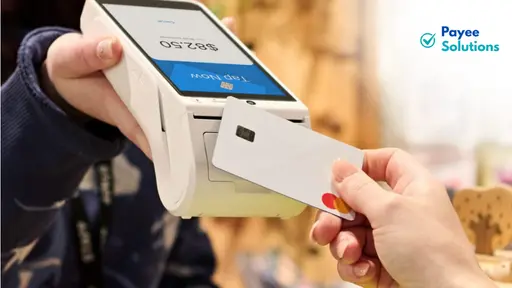
A card machine accepts and processes debit cards, credit cards and supported digital wallets. Its main job is moving a payment through the card-processing system and returning an approval or decline.
A donation terminal is designed primarily for voluntary giving. Depending on the system, it may present preset donation amounts, accept contactless donations or connect to fundraising software.
A charity-shop EPOS system manages the wider retail transaction. Depending on the system, that can include product categories, stock, till totals, refunds, staff accounts, reporting and Retail Gift Aid-related records.
Some platforms combine several of these functions. Others use separate payment and EPOS systems connected through an integration.
Does a charity shop need a special card machine?
Not necessarily. An ordinary commercial card terminal can process normal retail payments in a charity shop.
What makes charity retail different is the system around the terminal. The charity may need appropriate EPOS, Gift Aid, stock, reporting and permission controls that an ordinary standalone reader does not provide by itself.
A £10 sale and a £10 voluntary donation may use the same physical terminal, but they should not automatically enter the charity’s records in the same way.
Use the Six-Factor Test to Compare Charity-Shop Card Machines
Instead of comparing providers from transaction rate alone, assess the full payment setup across six areas.
| Factor | What to assess |
| Checkout | Is the payment process simple and efficient? |
| EPOS | Does the terminal integrate with the till system where required? |
| Gift Aid | Can the wider system support the charity’s Retail Gift Aid records? |
| Control | Can access, refunds, voids and staff permissions be managed appropriately? |
| Cost | What is the complete cost of accepting card payments? |
| Scale | Can the setup support more tills, devices and branches? |
This is a practical evaluation framework for this guide rather than an official industry standard.
How to apply the six-factor test
A small independent charity shop with one till may care most about:
- simple operation
- low fixed costs
- easy daily reconciliation
- straightforward refunds
- dependable support
A national charity with 100 shops may instead need:
- consistent EPOS integration
- central reporting
- role-based permissions
- terminal management
- common refund controls
- Gift Aid workflow support
- branch-by-branch settlement visibility
The hardware may be similar, but the operational requirements are completely different.
That matters in a UK charity-retail sector with more than 9,900 charity shops and more than 223,500 volunteers. The Charity Retail Association also reports an average charity-shop transaction value of £7.51 for April–June 2026, which makes low-value transaction economics particularly relevant when comparing card-processing fees.
Which Setup Is Right? EPOS vs. Card Machine for Charity Shop
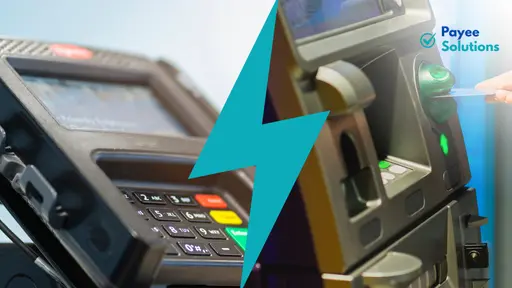
A card machine and an EPOS system perform different jobs.
What a card machine does
The payment terminal typically handles:
- debit and credit card acceptance
- contactless and supported wallet payments
- the payment request
- approval or decline
- the terminal transaction record
- refunds where supported by the provider and setup
What a charity-shop EPOS system does
An EPOS system can manage:
- items and product categories
- donated and new stock
- till totals
- sales reports
- refunds and voids
- discounts
- volunteer and staff accounts
- accounting exports
- branch-level reports
- Retail Gift Aid-related donor and item data where supported
The distinction is important because the payment terminal does not become a full retail-management system simply because it can accept cards.
Why EPOS integration matters
Imagine a customer buys several items for £14.50.
With a standalone setup, the volunteer sees £14.50 in the till and manually types 14.50 into the terminal.
The card machine then processes the payment separately.
With a suitable integration:
EPOS → £14.50 payment request → terminal → customer pays → result returns to EPOS
That can remove manual re-entry and make reconciliation easier.
It can also reduce the possibility of accidentally entering £41.50 instead of £14.50 or taking a payment without matching it correctly to the till sale.
But integration should never be treated as a blanket promise.
A terminal may integrate with the EPOS for payment amounts while leaving other functions—such as stock, refunds, accounting or Gift Aid—to separate workflows.
Always verify exactly what the integration supports.
Standalone vs EPOS-integrated card machines
| Factor | Standalone terminal | EPOS-integrated terminal |
| Payment amount | Usually entered separately | Can transfer automatically |
| Retail reporting | Often separate | Can link to till reporting |
| Stock management | Managed separately | Can fit the EPOS stock workflow |
| Reconciliation | May involve more manual checking | May reduce manual matching |
| Gift Aid workflow | Managed by relevant separate system | Can fit a supported integrated process |
| Setup | Often simpler | Requires compatible software/configuration |
| Best suited | Simpler payment needs | Shops relying on connected retail operations |
An integrated system is not automatically better. It is better only when the integration solves a genuine operational need.
How Retail Gift Aid Works With Charity-Shop Card Payments
This is where charity retail differs most clearly from conventional high-street retail.
A card payment does not make a retail purchase Gift Aid eligible
The shopper may pay by debit card, credit card, cash or mobile wallet. That payment method does not determine whether Retail Gift Aid applies.
HMRC states that Gift Aid applies only to gifts of money. If someone simply donates clothes, books or other physical goods to a charity, the goods themselves do not qualify for Gift Aid.
Under qualifying Retail Gift Aid arrangements, however, the charity or its trading company can act as an agent for the owner of the goods.
The item is sold on the owner’s behalf. The owner can then agree for eligible net sale proceeds to be donated to the charity. Subject to HMRC’s conditions, Gift Aid may be claimed on those donated proceeds.
HMRC currently recognises the Standard Method, Method A and Method B for operating Retail Gift Aid, depending partly on whether shops are operated directly by the charity or through a trading subsidiary.
What does the card machine do?
The terminal processes the shopper’s payment.
That is all.
It does not independently determine:
- whether the original goods donor is eligible
- whether a valid Gift Aid declaration exists
- which Retail Gift Aid method the charity operates
- who owns the sale proceeds at a particular stage
- whether a Gift Aid claim should be made
Those are handled through the charity’s wider systems and procedures.
What should the EPOS or Gift Aid system record?
Where the charity operates Retail Gift Aid, the wider system may need to preserve connections between:
donor → donated goods → item identification → retail sale → relevant proceeds → donor records
HMRC’s guidance specifically describes the need to identify goods so that sale proceeds can be linked back to the donor.
The Charity Retail Association likewise describes Retail Gift Aid as a major part of charity retail and provides HMRC-compliant guidance, templates and training for the sector.
Illustrative Retail Gift Aid workflow
Donor gives an item
↓
Donor and applicable Gift Aid records are created or identified
↓
Item is identified and linked to the relevant donor
↓
Item enters the charity-shop stock process
↓
Shopper purchases the item
↓
EPOS records the retail sale
↓
Card terminal processes the shopper’s payment
↓
Relevant sale/proceeds records remain linked to the donor
↓
Eligible proceeds follow the charity’s applicable Retail Gift Aid process
This is an illustrative technology workflow. The charity’s actual process and recordkeeping must satisfy the relevant HMRC rules.
Questions to ask about Retail Gift Aid compatibility
When evaluating an EPOS/payment setup, ask whether:
- Gift Aid-covered goods can be identified appropriately
- relevant donor records can be retrieved
- sales remain linked to donor/item records
- refunds and corrections are handled correctly
- the system supports the charity’s chosen operating method
- required reports can be exported and checked
A card-machine salesperson saying “yes, we support Gift Aid” is not enough. Ask which part of the process the product actually supports.
How Should Charity Shops Record Retail Sales and Donations?
A charity shop can receive money through several routes, and categorisation matters.
| Transaction | Appropriate treatment |
| £10 for second-hand books | Retail sale |
| £10 voluntarily given with nothing received | Direct donation |
| £10 purchase plus separate £2 donation | Two transaction types |
| Contactless tap-to-donate | Donation under the relevant fundraising process |
| Sale of goods under Retail Gift Aid | Retail sale linked to the applicable Retail Gift Aid process |
Why sales and donations need separate records
Sales and donations serve different accounting and tax purposes.
A customer buying a jacket has received goods in return for the payment.
A supporter donating £10 without receiving anything has made a donation.
The fact that both transactions occur in a charity shop does not make them equivalent.
A suitable EPOS configuration can help staff select the correct transaction type and preserve a clearer audit trail.
Can a charity shop accept contactless donations at the till?
Potentially, yes.
A charity could configure an appropriate donation option or use a separate contactless fundraising solution, depending on its payment and EPOS setup.
The important point is that the direct donation should be distinguishable from a retail purchase.
Is Gift Aid on contactless donations the same as Retail Gift Aid?
No.
Retail Gift Aid concerns proceeds from the sale of qualifying donated goods under specific agency arrangements.
The Gift Aid Small Donations Scheme (GASDS) is different. HMRC currently says eligible charities may be able to claim a top-up on qualifying small cash and contactless donations of £30 or less, subject to the scheme’s conditions. HMRC also says charities should keep records of contactless donations, such as records produced by the payment terminal.
Do not merge the two concepts.
What Features Should a Charity-Shop Card Machine Have?
Once the wider workflow is clear, hardware becomes easier to evaluate.
Contactless, Chip & PIN and digital wallets
At minimum, check which payment methods the terminal actually accepts.
Contactless should now be treated as core functionality rather than a premium extra. UK Finance’s latest card-spending data says contactless represented 67% of credit-card transactions and 76% of debit-card transactions in the UK in June 2026.
Depending on the provider and terminal, also check support for:
- Chip & PIN
- Apple Pay
- Google Pay
- other mobile wallets
- major card schemes used by your customers
Those UK Finance figures are for UK card activity overall, not charity shops specifically.
Countertop, portable or mobile
A fixed countertop terminal may suit a permanent till.
A portable terminal can be useful for:
- queue management
- furniture departments
- accessible checkout
- temporary tills
- donation centres
- shop-floor transactions
A mobile/cellular terminal may also suit pop-ups, warehouse sales or fundraising events.
EPOS compatibility and payment confirmation
Do not ask only:
“Does it integrate?”
Ask:
“What exactly happens when it integrates?”
Confirm:
- whether the payment amount transfers automatically
- whether approval/decline returns to the till
- whether refunds synchronise
- whether end-of-day totals reconcile
- which exact EPOS version is supported
Connectivity and battery life
A fixed till may rely on Ethernet or stable Wi-Fi.
A portable or mobile terminal may need:
- reliable Wi-Fi
- cellular connectivity
- adequate battery
- a charging dock or scheduled charging
Choose according to the shop’s real layout rather than the most impressive specification.
Receipts, refunds and reporting
Check whether the setup supports:
- printed receipts
- digital receipts
- transaction lookup
- refund records
- daily card totals
- terminal-level reports
- branch-level reporting
Support and terminal replacement
Ask a practical question:
What happens if our only terminal fails at 11am on Saturday?
Find out:
- support hours
- telephone support availability
- remote troubleshooting
- replacement time
- replacement cost
- whether a spare terminal can be held or added
How to Choose a Card Machine That Volunteers Can Use Confidently
Volunteers are central to charity retail.
The Charity Retail Association currently reports more than 223,500 volunteers in UK charity retail, and its October 2026 Gift Aid guidance highlights the importance of shop-team confidence and the challenges created by volunteer turnover.
A payment system therefore needs to work for people with varying levels of retail and technical experience.
Keep checkout simple
A volunteer should be able to understand:
- what amount is being charged
- whether payment succeeded
- whether a receipt is needed
- what to do after a decline
- when to ask a supervisor for help
Avoid unnecessary steps where technology can remove them.
Set appropriate permissions
A practical permission structure might look like this:
| User role | Possible permissions |
| Volunteer | Process sales and basic receipts |
| Supervisor | Authorise appropriate refunds or voids |
| Shop manager | Reports, discounts and overrides |
| Finance/head office | Reconciliation, branch reporting and configuration |
This is an example framework, not a required permission model.
Actual controls depend on the EPOS, card provider and charity’s internal policies.
Train staff on the entire transaction process
Training should include more than “press this button to take a payment”.
People operating the till should know how to handle:
- declines
- accidental duplicate attempts
- refunds
- receipts
- donation categorisation
- Retail Gift Aid-related processes relevant to their role
- escalation to supervisors
That becomes especially important in a sector where the average transaction value is currently only £7.51 but the volume of small transactions can be high.
Refunds, Voids and Exchanges: What Should Charity Shops Check?
Donation-only payment guides often overlook refunds because donations do not operate like normal retail purchases.
Charity shops do.
Void or cancellation
A void generally stops or reverses a transaction according to the terminal/provider process before it has fully completed the normal settlement cycle.
Exact terminology varies by provider.
Refund
A refund returns money from a completed transaction.
Check:
- who can initiate it
- whether the original transaction must be located
- whether the original payment method is required
- how long the process takes
- how the EPOS updates
Partial refund
If supported, a partial refund returns only part of the original payment.
This can matter when a multi-item sale is partly returned.
Exchange
An exchange is usually a retail-policy and EPOS workflow rather than simply a card-terminal function.
The shop should record both sides of the transaction correctly.
Essential controls
A charity should consider:
- supervisor authorisation
- role restrictions
- transaction lookup
- audit trail
- refund reason codes where supported
- consistent records between terminal and EPOS
A refund shown on the card terminal should also be checked against the EPOS and charity records. Whether that happens automatically depends on the integration.
What Should a Charity Shop Look for in an EPOS System?
The card terminal is only one part of the buying decision.
| EPOS capability | What to verify |
| Donated-stock management | Can donated goods be recorded appropriately? |
| New-stock management | Can purchased goods be separated from donated stock? |
| Retail Gift Aid support | Does it support the required donor/goods/proceeds workflow? |
| Product categories | Can clothing, books, homeware and other goods be categorised? |
| Discounts and pricing | Can appropriate staff control adjustments? |
| Staff accounts | Can access and permissions be managed? |
| Refunds and voids | Are changes recorded consistently? |
| Sales reporting | Are daily and periodic reports useful? |
| Multi-site support | Can head office see branch-level information? |
| Accounting integration | Can information be exported or transferred? |
| Sector schemes | Are relevant charity-retail schemes supported? |
This is not theoretical.
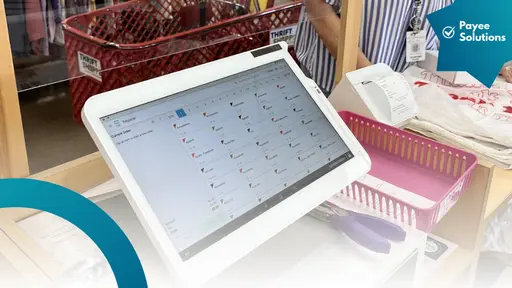
In April 2026, the Charity Retail Association reported that Headway rolled out a specialist charity-retail EPOS platform across 27 shops, with Gift Aid, volunteer/staff processes and reporting among the operational benefits.
In March 2026, it also reported a Salvation Army digital upgrade across more than 250 charity shops and donation centres, including mobile POS for busy periods and digital Gift Aid processes.
Those examples show why larger charity retailers evaluate much more than card acceptance.
How Much Does a Card Machine Cost for a Charity Shop?
There is no single meaningful charity-shop card-machine price.
The real cost can contain several elements.
Transaction percentage
Some providers charge a percentage of each transaction.
For example:
sale value × processing percentage
Fixed transaction charge
Other pricing structures include a percentage plus a fixed amount per payment.
That is especially important for low-value charity-shop purchases.
Terminal purchase or rental
Hardware may be:
- bought outright
- rented monthly
- included within another plan
Check ownership and replacement terms.
EPOS/software fees
The terminal price may not include:
- EPOS subscription
- Gift Aid module
- branch-management tools
- stock software
- additional user licences
Additional charges
Depending on the provider, costs may include:
- PCI-related charges
- authorisation fees
- minimum monthly service charges
- refund charges
- chargeback fees
- settlement charges
- additional terminal fees
- cancellation costs
Not every provider charges every item.
Do charity shops get special card-processing rates?
Some providers offer preferential pricing for eligible charities.
But the phrase “charity rate” does not tell you whether the overall deal is competitive.
Compare the complete cost, not the label.
Payee Solutions currently advertises charity-specific pricing and offers a line-by-line merchant-statement comparison, but the rate displayed on its charity page differs from the starting rate shown on its main pricing page. Any Payee-specific rate inserted into this article should therefore be internally verified before publication.
Why Low-Value Charity-Shop Sales Change the Fee Calculation
This is particularly important given the current £7.51 average transaction value reported by the Charity Retail Association for April–June 2026.
A fixed pence fee can have a much larger effect on a £5 sale than on a £50 sale.
Illustrative example only
Suppose two hypothetical plans charge:
Plan A: 1.7%
Plan B: 1.0% + 8p
| Transaction | Plan A | Plan B |
| £5 | 8.5p | 13p |
| £8 | 13.6p | 16p |
| £12 | 20.4p | 20p |
| £20 | 34p | 28p |
At £5, Plan A costs less.
At £20, Plan B costs less.
The lower percentage rate does not automatically mean the lower processing cost.
For a charity shop processing large numbers of inexpensive books, clothing or homeware items, this can materially affect annual costs.
Ask:
What does this pricing model cost at our actual average transaction value?
That question is often more useful than:
“What is your lowest advertised rate?”
How to Calculate the Effective Cost of Accepting Card Payments
A useful comparison measure is the effective payment cost.
Formula
Effective rate = relevant payment-processing costs ÷ card turnover × 100
Worked example
Suppose:
Monthly card turnover: £15,000
Relevant monthly costs: £165
Then:
£165 ÷ £15,000 × 100 = 1.10%
The interpretation depends on what you put into the £165.
If it includes only transaction charges, it reflects processing charges.
If it also includes:
- terminal rental
- account fees
- software
- other fixed costs
then it is more accurate to describe the result as an effective payment-setup cost.
Compare like with like
If you compare providers, use:
- the same turnover
- the same period
- the same card mix
- the same transaction count
- the same cost categories
Otherwise, the percentage becomes misleading.
How to Compare Card-Machine Quotes for a Charity Shop
When comparing card-machine quotes for a charity shop, look beyond the headline transaction rate. Consider processing fees, terminal costs, monthly charges, contract terms and whether the system supports your charity’s Gift Aid and EPOS processes.
The table below uses hypothetical figures for illustration only. They are not actual provider quotes or guaranteed market rates. Ask each provider for a written quote based on your charity shop’s expected card turnover and average transaction value.
| Cost or feature | Current provider | Provider A | Provider B |
|---|---|---|---|
| Consumer debit rate | 1.75% | 1.40% | 1.60% |
| Consumer credit rate | 1.85% | 1.50% | 1.75% |
| Fixed transaction fee | 5p | 5p | 0p |
| Terminal purchase/rental | £20/month | £15/month | £99 upfront |
| EPOS/software cost | £25/month | £20/month | £0/month |
| Other service fees | £10/month | £5/month | £0/month |
| Minimum monthly charge | £15 | £10 | None |
| Refund/chargeback fees | £0 / £15 | £0 / £20 | £0 / £15 |
| Settlement schedule | Next working day | Next working day | 1–2 working days |
| Contract and exit terms | 24 months; exit fee applies | 12 months; exit fee applies | No fixed term |
| Support/replacement | Phone support; replacement terms apply | Phone and email; replacement terms apply | Online support; replacement terms apply |
| EPOS compatibility | Compatible | Compatible with selected systems | Compatible with selected systems |
| Gift Aid workflow support | Manual recording | Integration available at extra cost | Requires separate workflow |
Illustrative comparison only. All rates, fees, service terms and compatibility details above are invented examples, not verified offers from real providers. Gift Aid functionality must be confirmed with the provider and your charity’s existing systems.
Before signing, verify
Get the complete commercial arrangement in writing.
That means understanding:
- pricing
- hardware
- EPOS
- settlement
- support
- cancellation
- renewal
- Gift Aid workflow compatibility
Do not rely solely on a verbal statement such as:
“Yes, it works with charity shops.”
Ask exactly how it works with your shop.
Countertop vs Portable Card Machines for Charity Shops
Neither is universally better.
| Factor | Countertop | Portable/mobile |
| Main use | Fixed checkout | Shop-floor or temporary checkout |
| Mobility | Limited | Higher |
| Connectivity | Often wired/Wi-Fi | Wi-Fi/cellular depending on model |
| Battery | Less important | Important |
| Common use | Main till | Queue management, mobile checkout, events |
Countertop terminal
Often appropriate when:
- transactions happen at one till
- the shop has stable connectivity
- the terminal remains beside the EPOS
Portable terminal
Can help with:
- queue-busting
- furniture departments
- mobility/accessibility
- temporary checkouts
- donation-centre sales
- fundraising events
Larger charity retailers may reasonably use both.
How Should Charity Shops Reconcile Card Payments?
Three numbers are often involved:
1. EPOS card sales
2. Payment-processor transactions
3. Funds deposited into the charity bank account
They do not necessarily match on the same calendar day.
Why differences happen
Possible reasons include:
- refunds
- voids
- cut-off times
- delayed settlements
- fees
- chargebacks
- adjustments
- timing differences
Example
Suppose EPOS shows:
£1,100 card sales on Monday
But Tuesday’s bank payout is:
£1,078
That difference should not immediately be treated as an error.
The finance team should check:
- settlement period
- provider fees
- refunds
- adjustments
- whether all Monday sales fell before the payout cut-off
Key principle
Card sales and bank settlements are related, but they are not necessarily the same number on the same day.
That is why useful processor and EPOS reports matter.
How Quickly Do Charity-Shop Card Payments Settle?
Settlement timing depends on the provider and merchant arrangement.
Authorisation
Authorisation is the approval/decline stage when the customer pays.
Settlement
Settlement is the later process through which approved transaction funds move according to the merchant agreement.
When comparing providers, ask:
- what is the normal payout timetable?
- are weekends different?
- are bank holidays different?
- are fees deducted before payout?
- are faster settlement options available?
- do those options cost more?
The fastest settlement is not automatically necessary for every charity, but predictable settlement makes reconciliation and cash-flow planning easier.
Security and PCI DSS: What Should Charity Shops Check?
Charity status does not remove card-payment security responsibilities.
The PCI Security Standards Council states that PCI DSS is intended for merchants involved in payment processing regardless of size or transaction volume, although smaller merchants can have simpler payment environments.
A charity shop should therefore pay attention to:
- supported payment hardware
- software updates
- user access
- secure logins
- payment-data handling
- provider guidance
- terminal security
- appropriate PCI validation requirements
Using a payment provider that follows PCI requirements does not automatically mean every responsibility of the merchant disappears.
The exact validation requirements can depend on the payment environment, acquirer and card brands.
Twelve Questions to Ask Before Choosing a Charity-Shop Card Machine
Use these as the final supplier test:
- Does the terminal work with our exact EPOS?
- Can our system distinguish retail sales from direct donations?
- Does our wider system support our Retail Gift Aid process?
- Can payment amounts transfer automatically from the EPOS?
- Can volunteer permissions be controlled?
- How are refunds, voids and exchanges recorded?
- Can we report by terminal, shop and user where required?
- What is the complete cost of card acceptance?
- Are there fixed pence-per-transaction charges?
- When are funds normally settled?
- What are the contract, renewal and exit terms?
- What support and replacement service applies if hardware fails?
If a provider cannot give clear answers, do not let a low transaction rate compensate for uncertainty elsewhere.
Charity-Shop Card Machine Checklist
| Area | What to verify |
| Checkout | Simple for staff and volunteers |
| Terminal | Required payment methods and suitable hardware |
| EPOS | Exact compatibility and integration behaviour |
| Gift Aid | Required donor/goods/proceeds workflow |
| Sales/donations | Correct transaction categorisation |
| Stock | Donated and new goods handled appropriately |
| Refunds | Permission controls and audit trail |
| Users | Role-based access |
| Reporting | Daily, terminal, refund and branch reports |
| Fees | Complete written breakdown |
| Settlement | Clear payout schedule |
| Contract | Duration, renewal and exit |
| Support | Availability and replacement |
| Scale | Ability to add tills, terminals and branches |
| Sector schemes | Relevant Gift Aid/gift-card compatibility |
Frequently Asked Questions About Charity-Shop Card Machines
What type of card machine is best for a charity shop?
The best option depends on the shop’s EPOS, checkout layout, volunteer requirements, transaction volume, reporting needs and total processing cost. A simple shop may be comfortable with a standalone countertop terminal, while an EPOS-integrated setup can be more useful where stock, refunds, reporting and Retail Gift Aid records form part of a connected retail workflow.
Do charity shops need a special card machine?
Not necessarily. A standard commercial terminal can process retail card payments. Charity shops may, however, need specialist EPOS or Gift Aid functionality around the terminal to manage donated stock, donor-linked records, refunds, volunteer permissions and multi-site reporting.
Can charity shops claim Gift Aid on card sales?
A card payment does not itself make a retail sale eligible for Gift Aid. HMRC says Gift Aid cannot be claimed directly on donated goods. Under qualifying Retail Gift Aid arrangements, eligible net sale proceeds from goods sold on a donor’s behalf may later be donated to the charity and potentially qualify, subject to the applicable rules.
Does a card machine handle Retail Gift Aid?
No. The card terminal processes the shopper’s payment. The charity’s EPOS, Gift Aid software and operating procedures must handle the relevant donor, goods, sale and proceeds records required by the chosen Retail Gift Aid arrangement.
Can a charity shop accept donations through its card machine?
Potentially, yes, where the payment system supports that workflow. Direct donations should be recorded appropriately and distinguished from ordinary retail purchases. Small qualifying contactless donations may also fall within GASDS, subject to HMRC’s eligibility and recordkeeping rules.
Are card-processing fees lower for charities?
Some providers offer charity-specific pricing, but the lowest advertised rate may not produce the lowest total cost. Compare transaction percentages, fixed pence charges, terminal costs, EPOS/software fees, minimum charges and contract terms using your actual transaction volume and average sale value.
Can volunteers use a charity-shop card machine?
Yes. The key is choosing a setup with clear checkout prompts, straightforward payment confirmation, suitable training and appropriate access controls. Refunds, overrides and administrative settings may be restricted to supervisors or managers depending on the EPOS and charity’s internal policy.
Should a charity shop use an EPOS-integrated card machine?
Integration can be valuable when the shop needs payment amounts to pass directly from the till to the terminal, or where linked reporting and reconciliation reduce manual work. It is not mandatory for every charity shop. Verify the specific functions supported by the actual terminal and EPOS combination.
How quickly do charity-shop card payments reach the bank?
Settlement depends on the provider, merchant agreement, cut-off times, weekends, bank holidays and the bank receiving the funds. Ask for the exact settlement timetable and whether fees are deducted before the money reaches the charity’s account.
What is the cheapest card machine for a charity shop?
There is no universally cheapest option because charities have different transaction sizes, volumes and software requirements. A provider with a lower percentage fee can still cost more if it adds fixed transaction charges, terminal rental or monthly software fees. Compare the complete annual cost using your actual data.
Choosing a Payment Setup That Fits Your Charity Shop
Return to the six factors:
Checkout → EPOS → Gift Aid → Control → Cost → Scale
A suitable charity-shop payment setup should make everyday sales easier without making the wider operation harder to control.
The card machine must accept the payment reliably.
The EPOS should support the shop’s actual retail processes.
Where Retail Gift Aid is used, the wider system needs to preserve the required donor, goods and proceeds records.
Volunteer permissions should be appropriate.
Fees should make sense at the shop’s real transaction values.
And the system should still work if the charity adds another till, another shop or another hundred shops.
The goal is not simply to find the lowest advertised card rate.
It is to find the payment setup that fits the charity’s retail operation as a whole.
Reviewing your current card-processing costs? Payee Solutions currently offers charity payment solutions and invites organisations to provide an existing merchant statement for a line-by-line comparison. Compare the full cost, EPOS compatibility and contractual terms before deciding whether switching is worthwhile.